


FamilySearch (historical records search)
The best free starting point for almost any family history search, from census records to church registers.
Free account needed to searchSome records only at a center or library
A family history starter kit for beginners
A calm, step-by-step kit for finding your roots: write down what you know, ask the people who remember, search records that are free to use — and keep track of everything you find.
The one habit that matters most
Family stories are precious — and they drift as they’re retold. Records can be wrong too. So beside every name, date and place on every form, there’s one small circle that shows how you know it.
Try it
“Grandma Anna’s maiden name was Hudak.”
How do you know?
From the kit’s fictional example family.
A shoebox of photos, a few names nobody wrote down, a story Grandma used to tell. The kit starts there — with what you already have.
Plenty of records are free, if you know where to look and what “free” really means on each site.
Which spelling did you try? Which website was that census on? A simple log means you never search the same place twice.
One small habit keeps what you were told separate from what a record confirms — without losing either.
How it works
Each sitting takes about 45 to 60 minutes and has one goal and one or two forms. Do one a day, one a weekend, or one whenever you have a quiet hour. Every step has a worked example using a clearly labeled fictional family.
After the seventh, you have the whole method: plan, search, log, weigh — and a next question to start again.
One box or folder of family papers and photos — and a list of what’s in it.
A four-generation Starter Map, filled in from memory, every fact marked.
One conversation, written up — and a list of things to check.
One person, one answerable question, and where to look first.
Your searches carried out — including the ones that find nothing.
A research log you can trust, and your first filled-in dots.
Disagreements thought through, and your next question chosen.
Look inside
Clear type, room to write, nothing that wastes your printer ink. Select a page to see it larger.
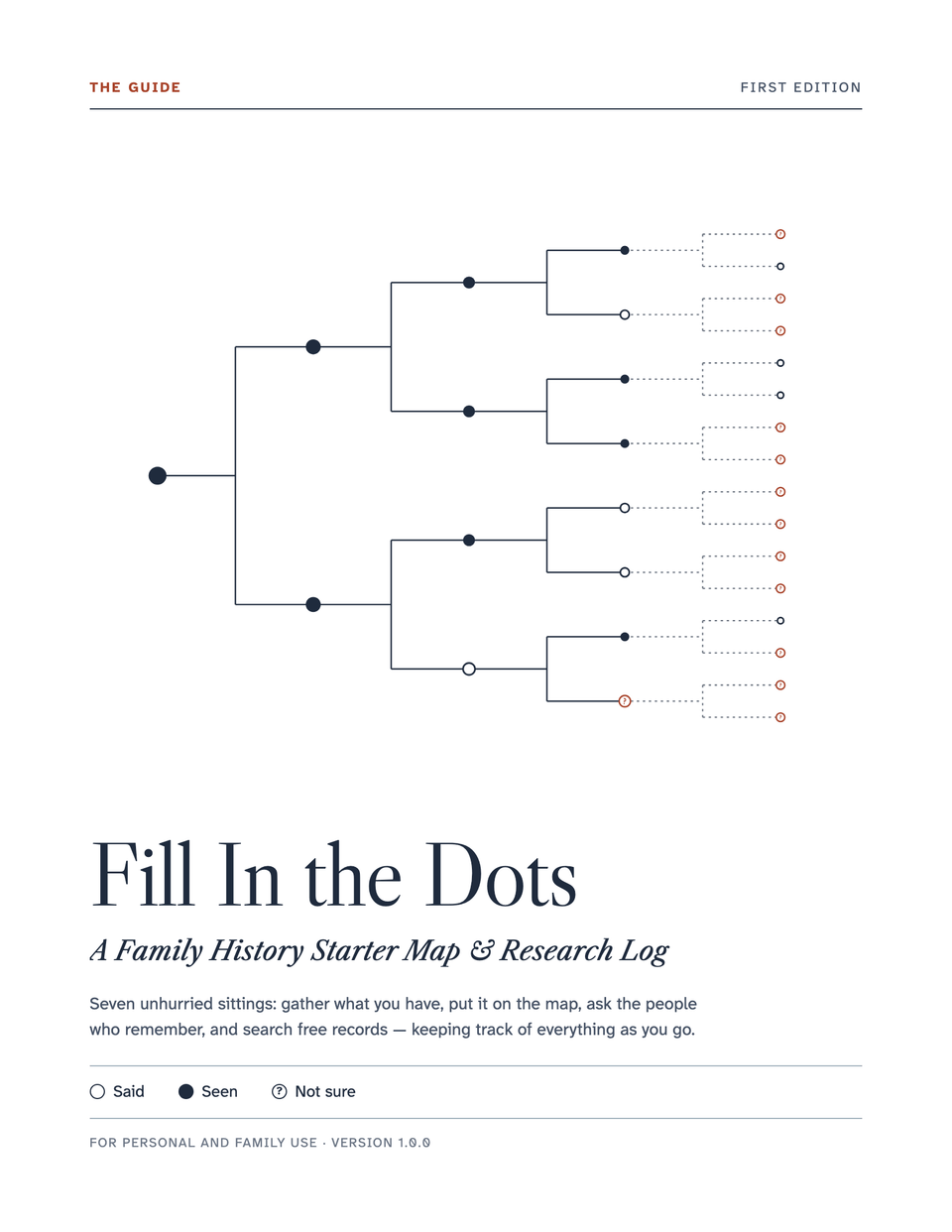
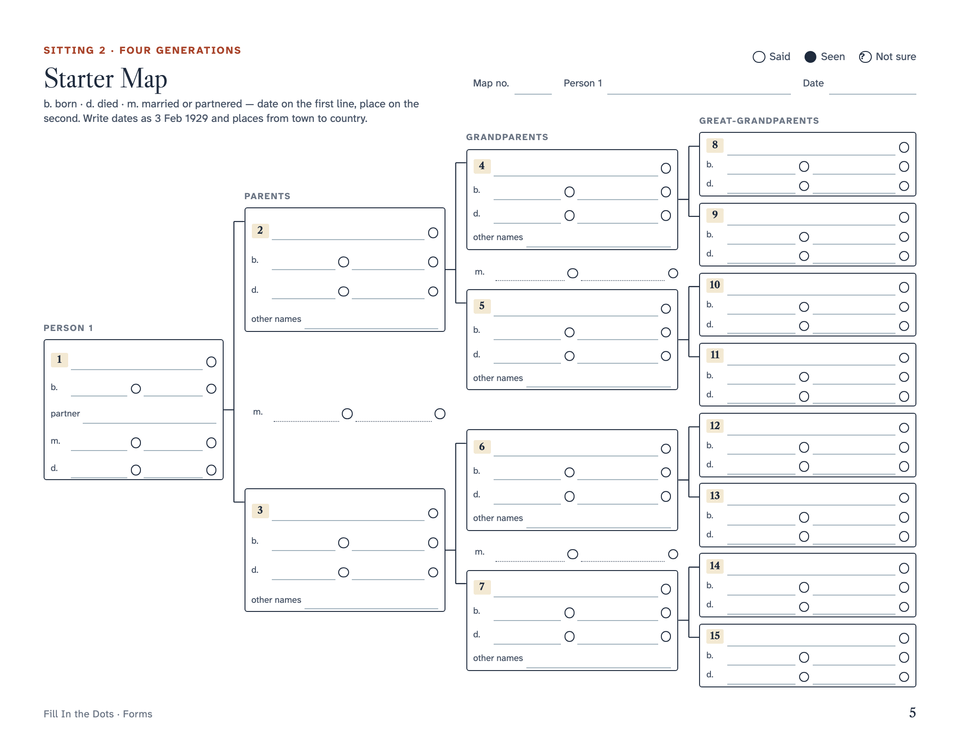
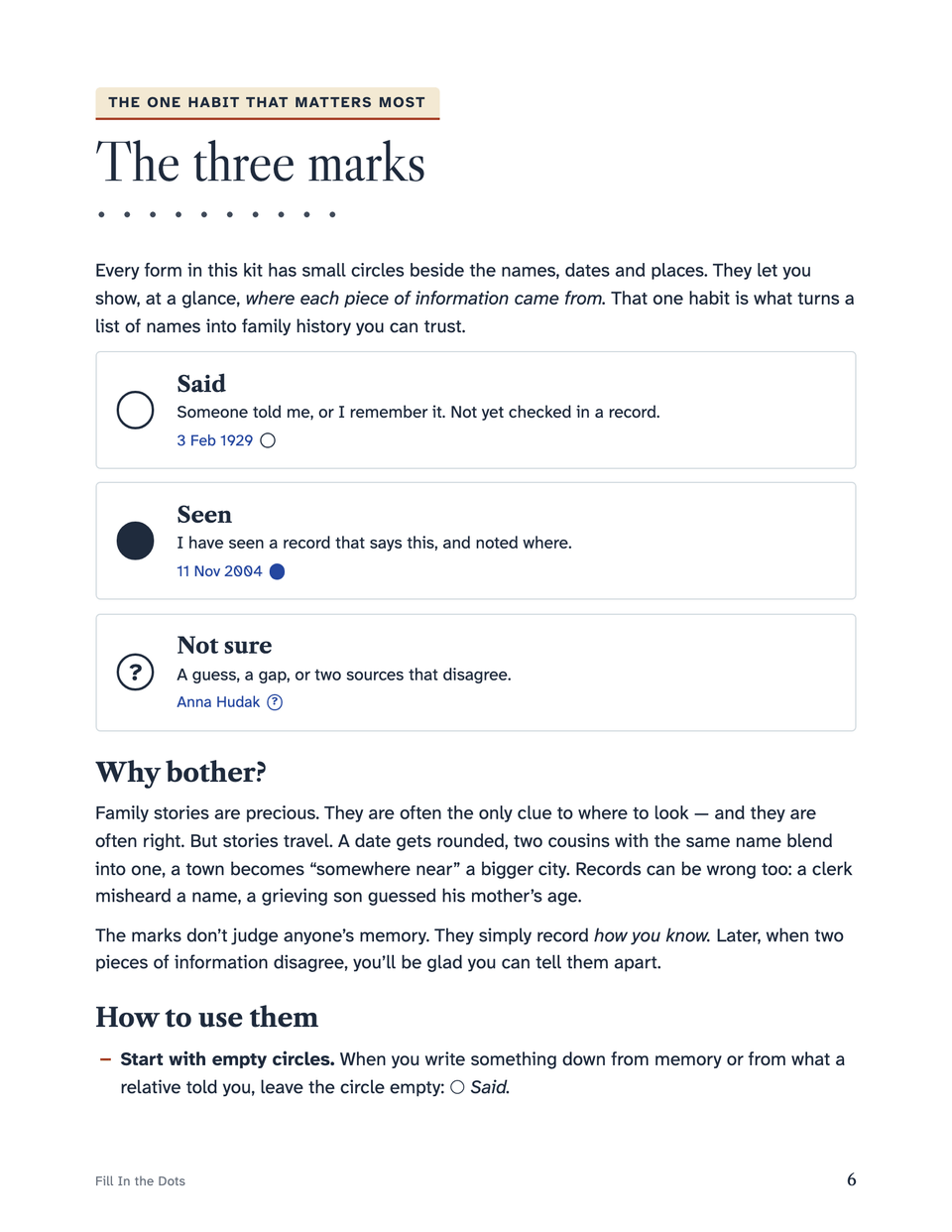
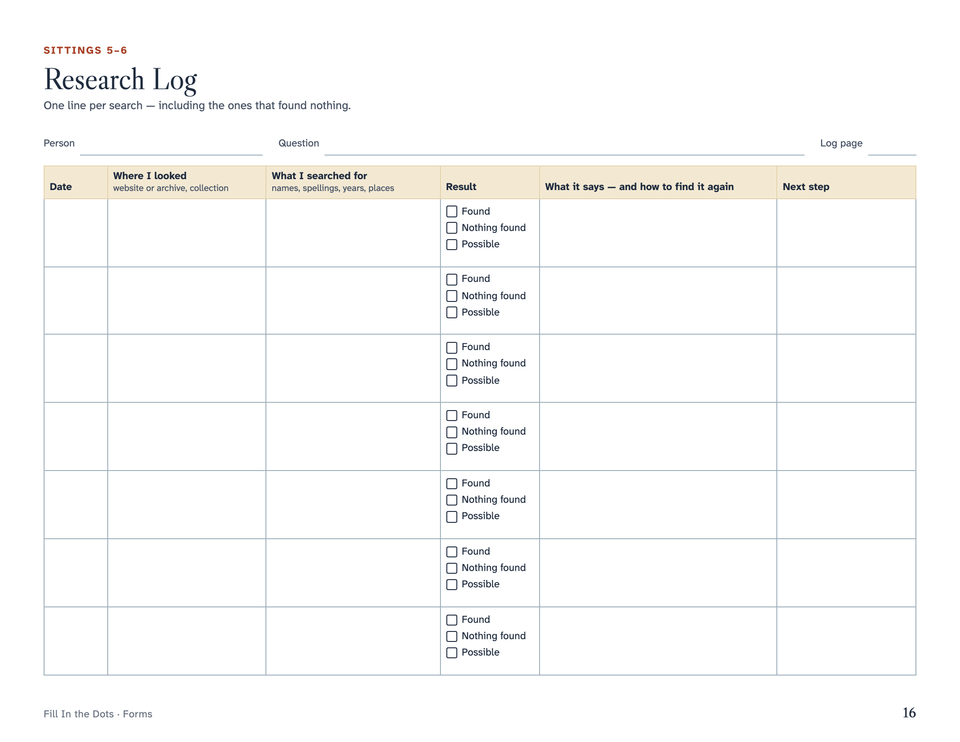
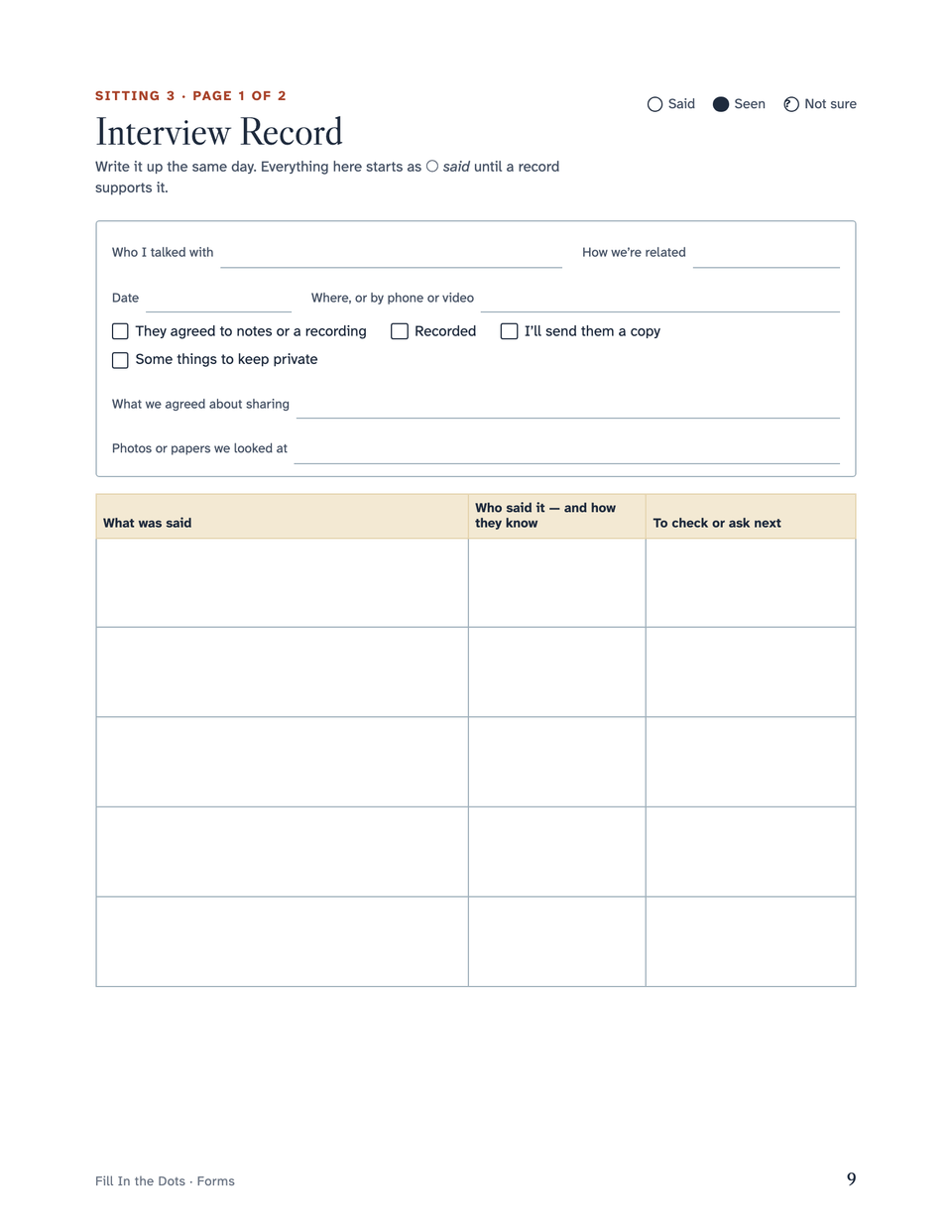
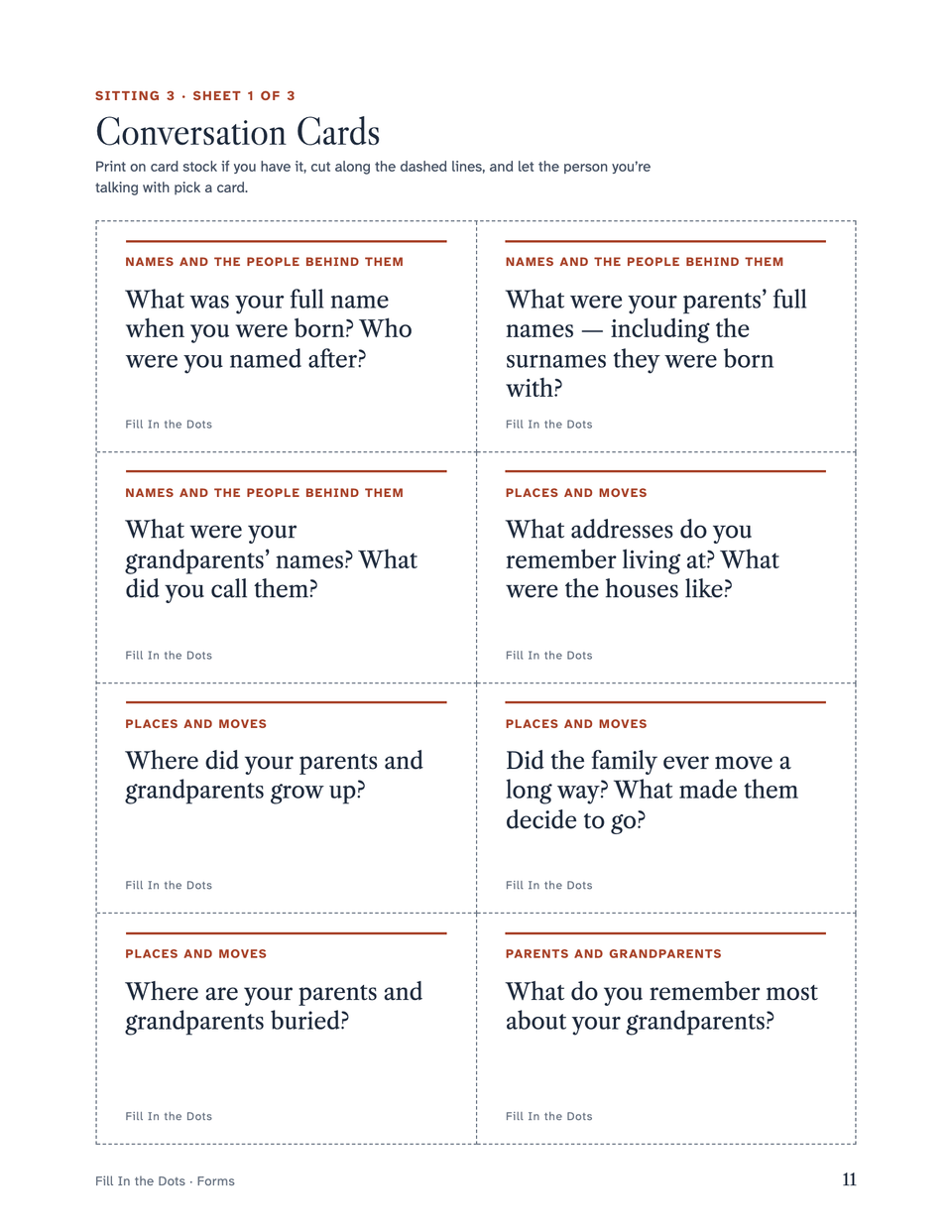
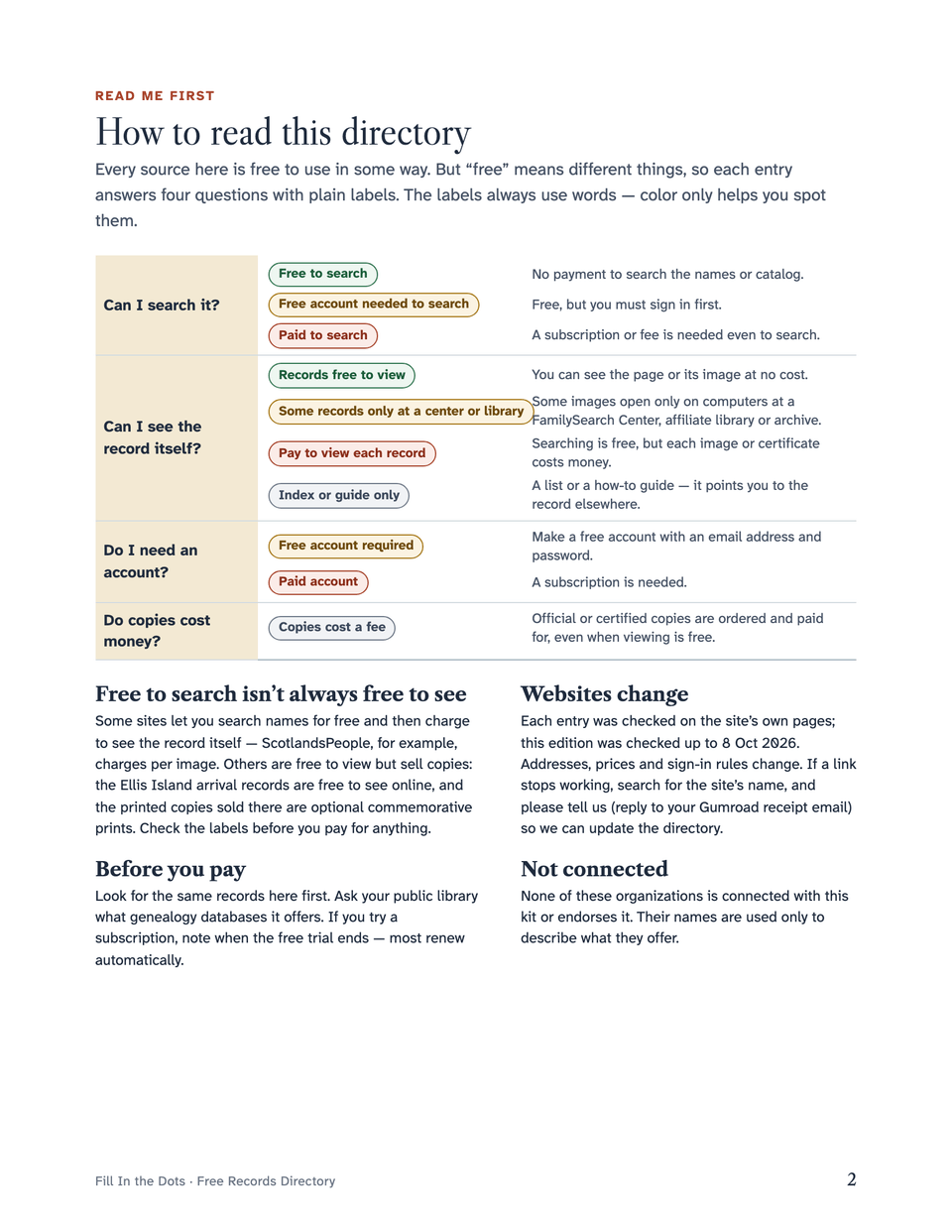
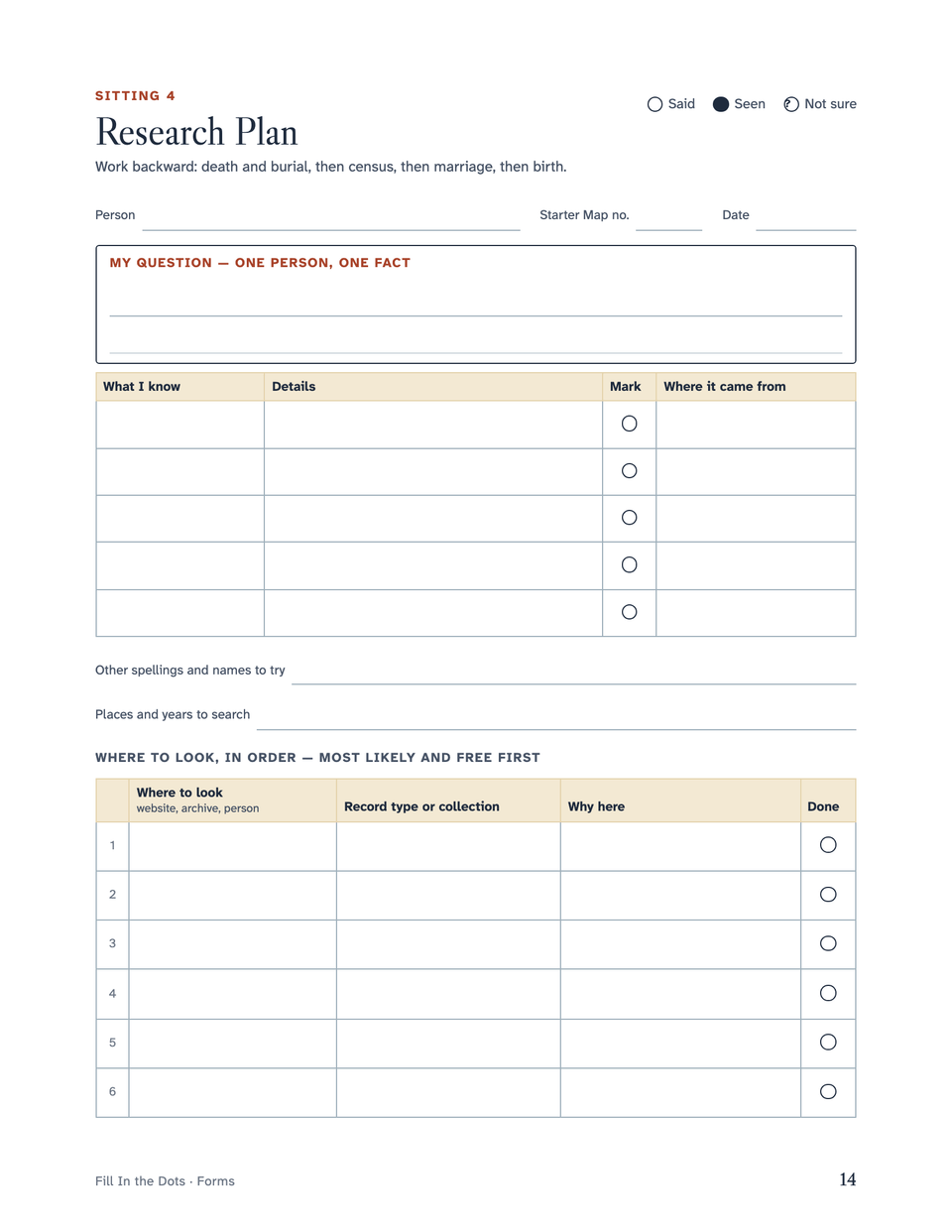
The Free Records Directory
Some sites let you search for free and then charge for the record. Others are free, but only with an account, or only on a library computer. The directory lists 117 sources across the United States, Canada and the countries many families came from — each checked on its own website and labeled on four questions:
This edition’s directory was checked up to 8 October 2026.
Try a few — where would you look?
The best free starting point for almost any family history search, from census records to church registers.
Learning what records exist for a place and where to find them online or offline.
Finding where a relative is buried, a headstone photo, and links to family members’ graves.
A sample of 16 sources. The full directory in the kit has all 117, with notes and tips for each.
What you get
Works with: any PDF reader (Adobe Acrobat Reader, Preview, most browsers) · Excel, Numbers or Google Sheets · any home printer, in black and white.
US$27one payment
Instant download. No subscription. The price is in US dollars; Gumroad’s checkout may show it in your local currency (you can switch back to USD) and adds any sales tax or VAT. Sending it as a gift and adding a tip are optional.
Get the kit30-day refund. If the kit isn’t useful to you, reply to your Gumroad receipt email within 30 days of purchase and ask for a refund. You’ll get your money back — you don’t need to explain or return anything.
Free sampler · 7 pages
The three marks, a blank Starter Map you can print or type into, twelve questions to ask your relatives, and six free places to search. No email address needed — just download it. Share it with anyone.
Fill In the Dots is published by Wren & Co.. It’s an independent guide, written for beginners in plain language, and its factual advice follows the published guidance of national archives, libraries and genealogical standards bodies — the guide lists every source it relied on. It isn’t connected with FamilySearch, Ancestry, or any organization it mentions.
No. The kit is built around sources that are free to use — FamilySearch, national archives, libraries and volunteer projects — and the Free Records Directory labels exactly what each one lets you do without paying. If you ever decide a subscription is worth it, the guide explains how to try one without being caught by an automatic renewal.
It’s written for people in the United States and Canada, with both countries’ records covered in the guide and the directory. Because so many families came from somewhere else, the directory also includes free record sites for England and Wales, Scotland, Ireland, Germany, Italy, Poland, the Netherlands, Scandinavia, France and Portugal, and starting points for Mexico and other countries.
Yes. The first four sittings use only paper and conversation. When you do go online, the guide walks you through making a free FamilySearch account and how search forms work, in plain words. Everything can be printed.
Yes. The forms PDF has fillable fields: open it in a free PDF reader such as Adobe Acrobat Reader, or Preview on a Mac, click a line to type, and click a circle to fill it. The Research Workbook is a spreadsheet for Excel, Numbers or Google Sheets.
They’re designed for real families. Partners don’t have to be married, children can be marked as birth, adopted, step or foster, and you can keep a separate map for a birth family and an adoptive family. The guide also has a section on handling unexpected discoveries kindly.
Briefly and carefully. The guide explains what a DNA test can and can’t tell you, what to think about before testing, and why it doesn’t replace records. It isn’t a DNA guide, and no test is included.
No. Every example follows one invented family, clearly labeled as fictional wherever it appears, so you can see how each form and search works without anyone’s private history being used.
Checkout happens on Gumroad, the platform that sells and delivers the kit. As soon as payment goes through, Gumroad shows your files and emails you a receipt with a link to them. You don’t need to create an account. Keep that email — its link always brings you back to your files.
The price is US$27. At checkout, Gumroad may show the equivalent in Canadian dollars or your own currency, and adds any sales tax that applies where you live.
If the kit isn’t useful to you, reply to your Gumroad receipt email within 30 days of purchase and ask for a refund. You’ll get your money back — you don’t need to explain or return anything.
Print as many copies of the forms as you like for yourself and your family, and work on your family history together. Please don’t post the files online or resell them. The free sampler, on the other hand, can be shared with anyone.
Each directory entry shows the date it was checked. If a link stops working, search for the site’s name — and let us know, so it can be corrected in the next update.
Look for an email from Gumroad with your receipt, and select its link to open your files. Can’t find it? See Find your download.
An educational guide and set of templates. No records are included, and no discoveries are promised.

